OneSourceIT / Custom internal tools

Your operation isn't off-the-shelf. Why is your software?

The spreadsheet that became load-bearing. The subscription that almost fits. The pricing rules that live in one person's head. I build the tool that fits your operation exactly — and runs without a subscription, a per-seat fee, or a support contract.

6 tools built for real, live operations Versioned releases with written release notes Fixed price · no subscription, ever
The problem

The three ways operations software goes wrong

Every business runs on a workflow no product was designed for. The workarounds pile up in one of three shapes:

Shape · 01

The load-bearing spreadsheet

It started as a quick list. Now orders, pricing, or scheduling live in it, three people edit it at once, and one bad paste can cost a customer.

The fix: a small, purpose-built tool that does that one job properly — with the history, the checks, and the reports the spreadsheet never had.
Shape · 02

The subscription that almost fits

Per-seat pricing forever, a forced workflow that isn't yours, and 90% of features you'll never open — because it was built for everyone, which means no one.

The fix: a tool shaped to your workflow instead of the other way around — paid for once, owned outright.
Shape · 03

The rules in one person's head

Pricing, copays, contract rates, job quoting — somebody knows how it works, and everybody else asks them. When they're out, the answers stop.

The fix: those rules encoded into a calculator anyone can use — consistent, checkable, and still there after the expert retires.

The economics mirror the rest of this practice: a recurring subscription or a daily workaround becomes a one-time fixed price — for a tool that's yours.

Proof, not promises

Built for real operations — here's one

Lead case · anonymized

A machine shop's whole work-tracking system

A machine shop needed to know a simple thing that no off-the-shelf product would tell it: where does the shop's time actually go? Orders moved through the floor on paper and memory; productivity was a feeling, not a number.

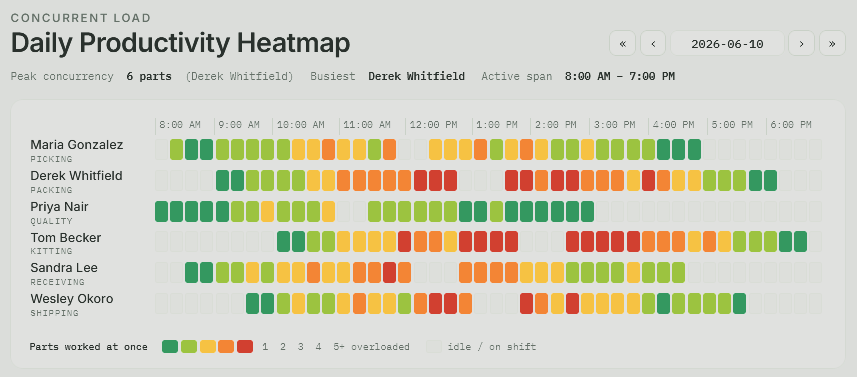
The tool I built became the shop's operating rhythm. Workers badge in and out of jobs with a barcode scan — no keyboards on the floor, no forms. The system keeps the order log, generates the packing slips, and turns the scans into reporting the owner actually wanted: a 15-minute-interval heatmap of worker activity showing exactly where the day went, plus order and task views for the office.

It was run like a product, not a favor: versioned releases, each with a written change log, planned features tracked and delivered, and the edge cases of a real floor handled — like workers forgetting to badge out of one task before starting the next.

Daily productivity heatmap: six workers across departments, colored by how many parts each handled per 15-minute interval from 8 AM to 7 PM

The activity heatmap, from the live tool — each cell is a 15-minute interval, colored by concurrent load. Names anonymized.

Requirements gathered from the shop floor, built against the real order log, iterated on operator feedback after delivery. That lifecycle — not the code — is the product.

1 scan
To badge in or out of any job
15 min
Activity heatmap resolution
Versioned
Releases with written change logs
0
Subscriptions or per-seat fees
The rest of the roster

Same discipline, different operations

Patient intake · pain-management group

New Patient Tracker

Tracks new patients from first contact through scheduling — with referral-source analytics, so the practice could finally see which channels actually produce patients. Automated email notifications included.

Released, upgraded and documented like a product
Insurance rates · pain-management group

Contracting Calculator

Manages negotiated insurance rates across carriers, built directly against the practice's master fee schedule — the rules that lived in the contracting manager's head, made checkable.

Iterated on documented client feedback after delivery
Cost estimation · pain-management group

Copay Calculator

Estimates a patient's procedure cost by procedure code and payer, using the real allowable schedules — an answer at the front desk instead of a callback.

Multiple fee-schedule revisions carried through production
Point of service · pain-management group

Payment Estimator

Patient payment estimation at the point of service — what will this cost me, answered before the visit instead of on the bill.

Release notes and operational documentation shipped with it
Result delivery · clinical laboratory

Lab Results Portal

A web portal giving a clinical lab's clients direct access to their results — replacing manual result distribution with self-service delivery.

Public-facing · ran the lab's daily result delivery
Controlled environment · IoT

Closed-loop climate controller

A controller that chases the correct variable (vapor-pressure deficit, a moving target), with dual-band hysteresis across coupled heater/humidifier loops and fail-safe-off on stale sensor data — the rules an expert grower holds in their head, encoded and running unattended.

Two vendor IoT APIs integrated · fail-safe by design
What you get

Run like a product, owned like a purchase

Requirements from the people who do the work

Scoped with the operators, not just the owner — the tool fits the job as it's actually done, including the messy parts.

Built against your real data

Fee schedules, order logs, intake records — the tool is developed and tested against the data it will actually live on.

Versioned releases, written notes

Every release documented, every upgrade a known process. Small tools deserve product discipline too — that's why they last.

Yours, with no meter running

One fixed price. No subscription, no per-seat fees, no support contract required to keep it alive. Iteration after delivery is an option — never a dependency.

Fixed-scope offers

Ready-made ways to start

Each is a bounded project with one price, approved before work begins.

01

A custom internal tool

One tool built to fit a single job exactly — a tracker, a portal, a workflow — and that keeps running without ongoing support.

02

A calculator for your rules

The pricing, rates, or quoting rules your team keeps in their heads, turned into one reliable tool anyone can use — consistent and checkable.

03

An order or job tracker

Keeps track of the things moving through your operation — orders, jobs, cases — built for everyday use by the people on the floor.

04

Retire a load-bearing spreadsheet

The spreadsheet your business secretly runs on, replaced by a small proper tool — your data moved in, history kept, checks added.

Tell me about the spreadsheet everyone's afraid to break. Get a fixed price back.

A short conversation is enough to scope most tools — and the quote costs nothing.

Get a fixed quote